

In large, distributed campus settings, life safety systems must function reliably not only during normal operation, but during power outages, severe weather, and other emergency conditions.
In these environments, communication performance is a design responsibility. For facility operators, engineers, and system designers, the technology selected to support alarm signaling directly influences how systems behave under stress. As wireless communication options become more common, network selection has become a critical design and approval consideration—particularly in settings where reliability cannot be deferred to third-party public infrastructure.
While much attention is often placed on panels, devices, and detection technologies, the alarm communication infrastructure that carries and supervises alarm, supervisory, and trouble signals plays an equally critical role. AES Corporation supports this infrastructure through private, licensed wireless networks purpose-built for fire and life safety signaling.
Mission-critical environments are defined less by industry and more by consequence. These sites typically share characteristics that directly impact life safety system performance:
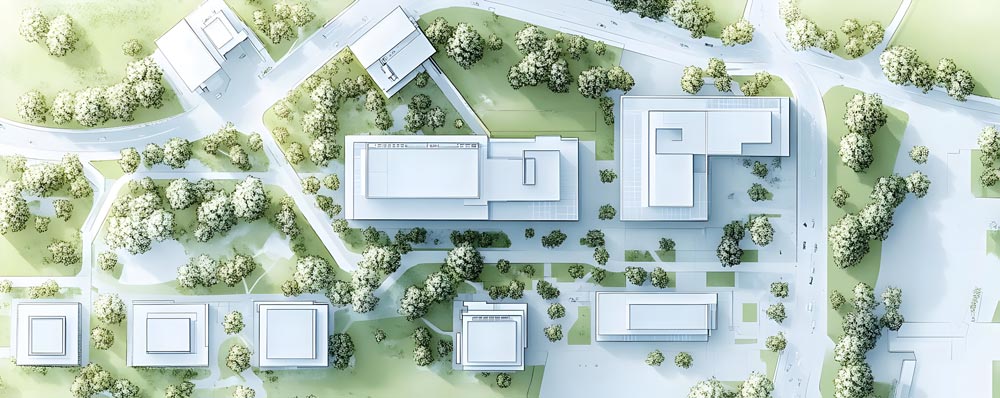
Healthcare systems, higher-education campuses, government and defense facilities, and other multi-building sites fall into this category. In these complex, multi-facility environments, coverage, redundancy, and signaling supervision become more challenging—and more important.
Public wireless networks, such as commercial cellular, are designed to support a wide range of users and applications. They are optimized for scale and convenience, but they are also shared infrastructures subject to congestion, prioritization decisions, maintenance schedules, and outages outside the control of system owners and designers.
In campus-scale environments, alarm signaling systems are often expected to perform during the same large-scale events that stress public networks—severe weather, power disruptions, or regional emergencies. From both an engineering and enforcement perspective, this introduces variables that can be difficult to predict or mitigate through design alone.
This distinction places greater emphasis on the communication model itself. Purpose-built communication infrastructure offers an alternative approach—one focused on predictable behavior, controlled access, and defined performance expectations. This is the design philosophy behind AES private wireless networks, which are built specifically for fire and life safety signaling rather than general-purpose communications.
A Difference in Control and Responsibility
When communication paths are part of a private, licensed radio-based network — as opposed to relying on public cellular infrastructure — reliability becomes a design and operational consideration rather than a dependency on public networks outside the control of system stakeholders. For more on how radio and cellular communication models differ in this context, see AES’s Radio vs. Cellular comparison.
Private, licensed wireless networks operate on regulated frequency bands assigned by the Federal Communications Commission (FCC) to specific users. These systems commonly use licensed spectrum in the 450–470 MHz range, as well as other approved VHF and UHF frequencies depending on system design and regional requirements.
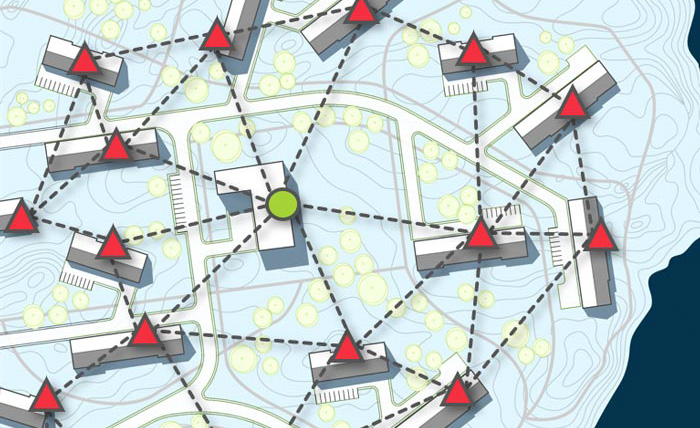
AES private wireless mesh networks operate on licensed spectrum and are engineered to support supervised fire and life safety communications across large, distributed sites. Because access to the spectrum is controlled and interference is minimized, licensed wireless networks provide more predictable performance than shared or unlicensed alternatives.
For fire and life safety systems deployed across campus-style facilities, this communication model supports:
In AES deployments, these characteristics are especially valuable where signaling infrastructure must remain supervised and resilient even when individual links or paths are disrupted.
NFPA codes and standards emphasize reliable transmission, supervision, and system performance under both normal and abnormal conditions. While requirements vary by application and occupancy, the underlying intent is consistent: alarm signaling must function when it is needed most.
AES networks are designed with this intent in mind, emphasizing continuous supervision, path diversity, and resilient network architecture. By reducing reliance on external public infrastructure and minimizing potential single points of failure, private, licensed wireless networks help reduce uncertainty—an important factor in approval confidence and overall system resilience.
To learn more about how AES aligns its technology with regulatory expectations and common compliance frameworks, visit AES’s Fire Marshal Resources.
High-consequence multi-facility settings exist across many sectors:
Across these environments, reliability, control, and resilience are foundational requirements.
Fill in your information below and choose a specific environment to download an informational flyer describing how AES private, licensed wireless networks are used in complex, multi-building settings.
"*" indicates required fields
In large, life safety–critical environments, alarm communication networks should be evaluated as infrastructure—not accessories. The question is not simply whether a wireless path exists, but whether that path is governed, controlled, and engineered to meet life safety expectations under worst-case conditions.
AES private wireless mesh networks are designed as infrastructure, with multiple communication paths and built-in redundancy that allow the network to adapt and continue operating if individual links are impaired. While private, licensed wireless networks may not be required for every application, they align well with the needs of complex, multi-building environments where consequences are high and margins for error are low.
Communication network decisions are most effective when addressed early in system planning and design. For engineers, property owners, and system designers, this allows network behavior to be incorporated into design assumptions and provides clearer visibility into how signaling infrastructure is expected to perform under adverse conditions.
In campus-scale, life safety–critical environments, private, licensed wireless networks are worth considering when reliability, resilience, and long-term performance are essential.
Complete the quick form below to schedule an obligtion free discovery call with a team member from AES.
"*" indicates required fields
×