

Multi-building environments rarely develop all at once. A college campus may include century-old academic buildings alongside new construction. A municipality may need to connect administrative buildings, public works facilities and remote sites. Hospitals, K–12 school districts, military installations and industrial campuses often face similar challenges: multiple facilities, different alarm systems and infrastructure that has evolved over many years.
Rather than treating every building as its own communications project, AES IntelliNet® provides a private wireless mesh network that can support fire, security and facility alarm communications across the property.
Running communications infrastructure between buildings isn’t always simple. On an established campus, roads, sidewalks and landscaping can make trenching difficult or disruptive. Remote buildings may be far from existing communications infrastructure. Some facilities may have newer alarm systems while others rely on equipment that has been in place for years.
And those needs rarely stay static:
Designing the communications path with the property’s current and future requirements in mind can help avoid solving the same problem building by building.
AES Subscribers communicate wirelessly with other Subscribers throughout the network using private, licensed frequencies.
This allows alarm signals to travel from building to building across large properties without requiring a dedicated wired communications path between each facility, while reducing or eliminating dependence on public internet and commercial carrier infrastructure.
Depending on terrain, obstructions, antenna placement and system design, AES Subscribers communicate an average of 3–5 miles between one another. The average AES communications packet travels through the network to central receiving equipment in 1–3 seconds.
That makes it possible to connect buildings spread across a large site using the same underlying communications network.
This is where the mesh architecture becomes important.
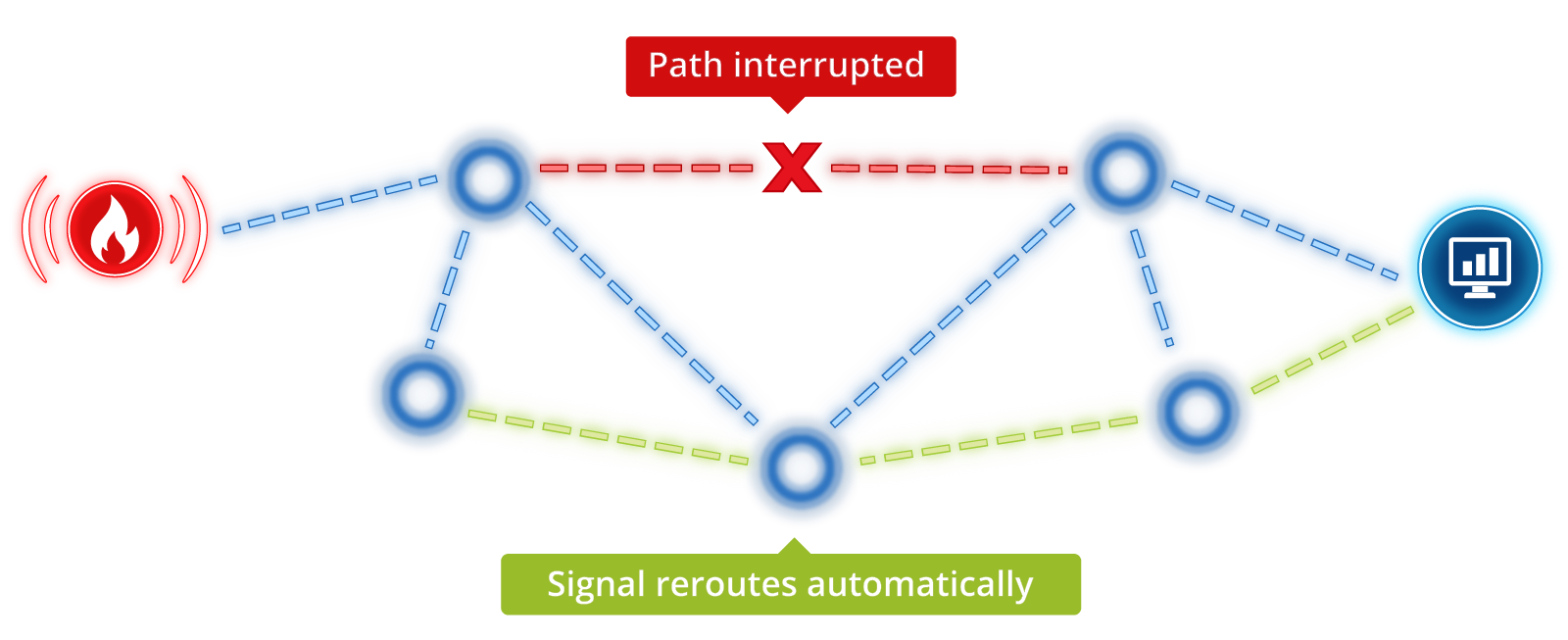
Each AES Subscriber can receive, repeat and relay signals from other Subscribers in the network. Signals have multiple available RF paths rather than depending on one fixed connection from the protected building to a central point.
If one path becomes unavailable, the network can reroute the signal through another available path.
This self-healing, multi-path architecture helps maintain communications as conditions around the site change.
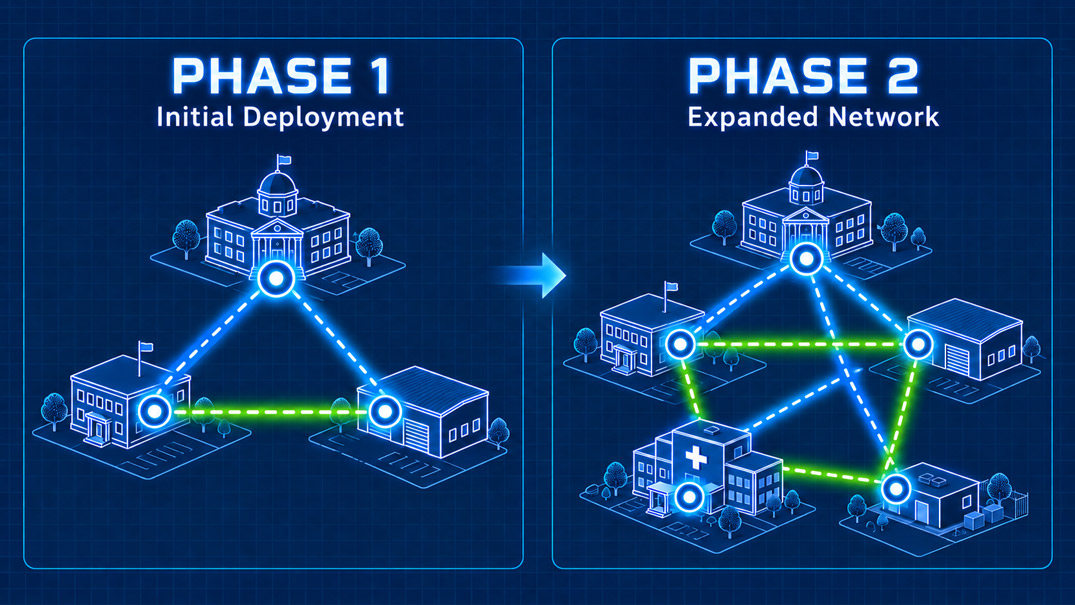
The buildings that need coverage today may not be the only buildings that need coverage in the coming years.
With AES technology, additional Subscribers can be incorporated into the existing network as new projects are completed.
That could mean adding a newly constructed academic building, bringing a maintenance facility onto a municipal network, modernizing an older fire alarm system or extending communications to a remote structure elsewhere on the property.
A huge benefit of how AES technology works is that adding another Subscriber does more than connect another building – it also adds another communication point to the mesh, creating additional potential paths for signals to travel.
AES technology is designed with backwards compatibility in mind, allowing existing and newer equipment to operate as campus networks are upgraded, renovated and expanded over time.
Fire alarm communications may be the primary concern on a life-safety project, but large properties often have other systems that also need to communicate.
The same AES network can support Fire, Security and Facility Subscribers, allowing multiple types of alarm communications to operate across the property.
That means a university could use the network for fire alarm communications in academic and residential buildings while also supporting security or facility monitoring elsewhere on campus. A municipality could connect fire systems in public buildings while monitoring facility conditions at a remote utility site.
AES technology also supports a range of reporting formats and panel interfaces, including Contact ID (CID), SIA, Pulse, BACnet and proprietary protocols from various fire alarm control panel manufacturers.
The goal isn’t to make every building or system the same. It is to provide a communications infrastructure capable of working across the differences already present on the site.
Although individual configurations vary, the basic communications path is straightforward.
An event originates at the protected building and is reported to an AES Subscriber. Subscribers then receive, repeat and relay the message across available RF peers in the IntelliNet® mesh.
At the receiving side of the network, equipment such as a Hybrid Subscriber can bridge RF communications to IP, while AES receiving and network management equipment delivers alarm information for monitoring and operator action.
The result is a communications path that can extend from an individual alarm panel to a campus-wide private wireless network and ultimately to the supervising station.
For professionals planning, specifying or managing alarm communications across a large property, the communications network should be considered part of the site’s long-term infrastructure.
AES can help address several priorities that become especially important as a site grows:
Whether the site is a university, K–12 school system, healthcare campus, municipality, military installation or another multi-building environment, the communications challenge is similar: connect what is there today without limiting what may be needed tomorrow.
One network. Multiple buildings. Built for resilience and flexible expansion.
Whether you’re planning a new campus network, upgrading existing alarm communications or adding buildings to an existing AES network, our team can help you evaluate the right approach for your site. Tell us a little about your project to start the conversation.
"*" indicates required fields
×