

An AES network is an investment you can keep putting to work. With the 3100S-PKG Solar Powered Subscriber, dealers and network owners can extend monitoring to remote outdoor applications, including lift stations, using their AES-IntelliNet private wireless mesh network.
The Solar Powered Subscriber package is designed for locations where a conventional electrical hookup for the communications equipment is limited, unavailable, or costly to install. It can also be configured as a repeater, giving a properly placed installation the potential to support both a new monitoring application and the surrounding AES network.
Lift stations are often located away from occupied buildings, but the conditions at these sites can still require a quick response. High water, a pump fault, loss of the station’s primary power, or unauthorized access can become a larger operational problem when no one knows that the condition has occurred.
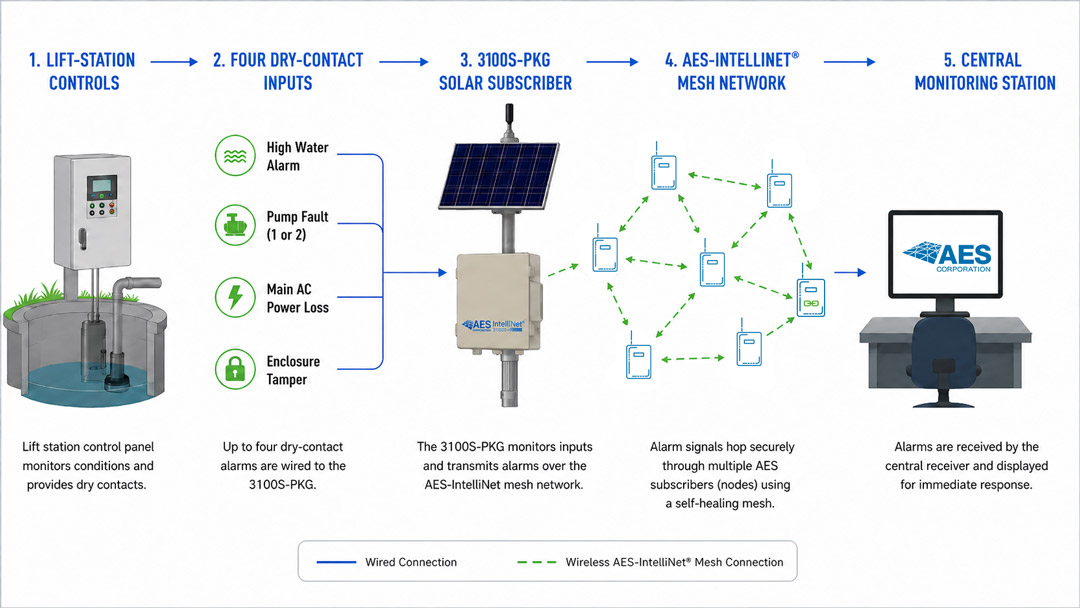
Where the local lift-station controller provides dry-contact outputs, the 3100S-PKG can monitor up to four selected conditions. This gives the installer flexibility to prioritize the alarms that matter most for the specific station, customer, and response plan.
The existing lift-station control equipment continues to sense water levels, operate the pumps, and identify local faults. Selected dry-contact outputs from that equipment are connected to the four monitoring inputs of the 3100S-PKG.
When a monitored contact changes state, the Subscriber can report the programmed alarm, trouble, or restoral event through the AES network to the central monitoring station. Programmable check-in intervals can also help confirm RF operation, while repeating can be enabled or disabled as part of the Subscriber’s radio configuration.
The solar panel, charging controller and battery all power the AES communications equipment – not the lift-station pumps.
The four inputs can be configured according to the available outputs and priorities at the installation. One possible arrangement is:
| Example Zone Input | Monitored Condition | Possible Source |
|---|---|---|
|
Zone 1 |
High-water alarm |
High-level float or local controller relay |
|
Zone 2 |
Pump fault |
Pump starter, overload, or general fault relay |
|
Zone 3 |
Main AC power loss |
Power-monitoring relay on the lift-station supply |
|
Zone 4 |
Enclosure or hatch tamper |
Cabinet or access-hatch switch |
These are example assignments rather than required programming. Final wiring and response procedures should reflect the station’s available dry contacts, operating requirements, and site risk assessment.
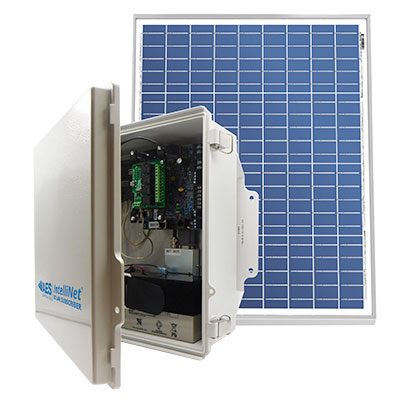
The 3100S-PKG includes a 50W solar panel, solar charging controller, AES-IntelliNet transceiver, 2.0 IntelliNet board, four-zone relay board, external-mount phantom antenna, mounting hardware, and a 12V 18Ah battery housed in a NEMA-rated outdoor enclosure.
Under specified load conditions, the included battery can support the Subscriber and relay-board load for up to 72 hours.
Lift-station monitoring expands the range of applications your existing AES network can support. Because the 3100S-PKG communicates through the AES network, the lift station does not require a separate public cellular connection or telephone line for alarm transmission.
The installation may provide an additional network benefit as well – when repeating is enabled and the location is suitable from an RF standpoint, the Subscriber can relay communications from other AES units. That means a lift-station installation may also help extend or reinforce network coverage in a location where conventional AC power for a Subscriber is not readily available.
AES technology uses a private, multi-path, self-healing mesh architecture. As network conditions change, available paths allow signals to be routed through other Subscribers rather than depending on a single public communications path.
A successful solar installation requires more than an open spot for the equipment. Site planning should consider:
For more information about how to install the 3100S-PKG Solar Subscriber from AES, visit the product page or download the Quick Start Guide and Product Manual below.
Lift station monitoring gives AES dealers another way to expand the services they provide using the network they already operate. With the 3100S-PKG, you can monitor critical conditions at remote sites while potentially adding another strategically located radio point to your network.
Contact your AES sales representative to discuss lift-station applications, RF coverage, and installation requirements.
 ×
×
Request pricing for the 3100S-PKG Solar Powered Subscriber and explore how it can support your next remote monitoring application.